Short Definition
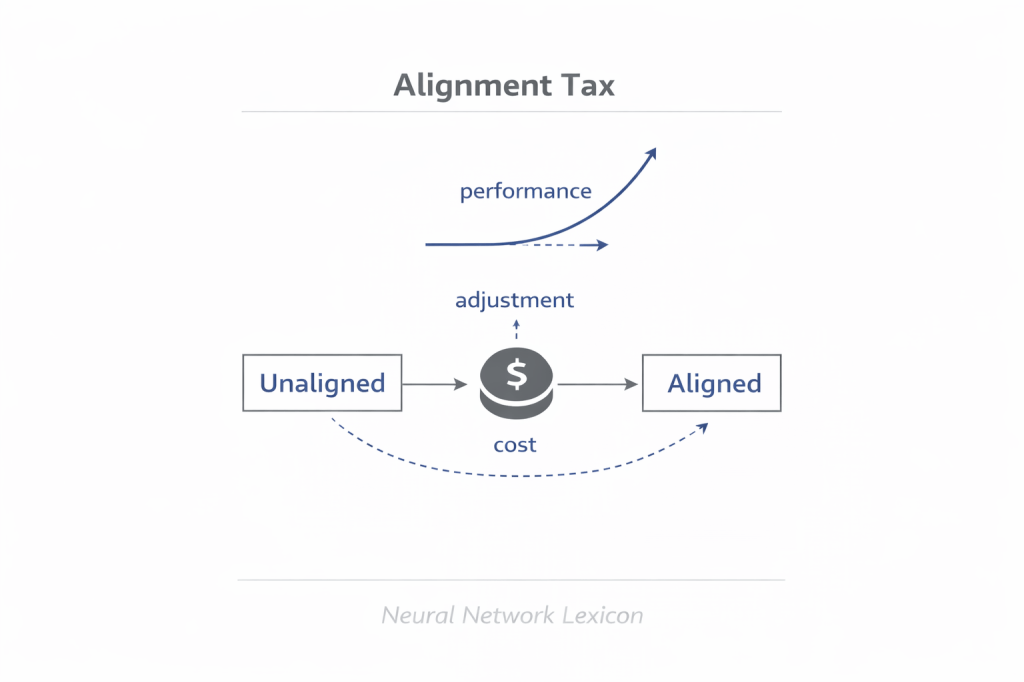
Alignment tax refers to the performance, efficiency, or capability cost incurred when modifying a model to improve safety, alignment, or compliance.
Definition
Alignment tax is the trade-off between maximizing raw model capability and implementing alignment mechanisms that constrain behavior. It describes the reduction in performance, flexibility, speed, or creativity that may occur when safety, governance, or behavioral control systems are introduced.
Safety may reduce unconstrained capability.
Why It Matters
When aligning models, developers often:
- Add safety filters
- Apply reinforcement learning from human feedback
- Restrict output domains
- Penalize unsafe behaviors
- Introduce oversight mechanisms
These interventions may:
- Reduce diversity
- Lower benchmark scores
- Increase latency
- Increase compute cost
Alignment has operational consequences.
Core Idea
Unconstrained optimization:
Maximize capability
Aligned optimization:
Maximize capabilitySubject to safety and behavioral constraintsConstraints change the solution space.
Minimal Conceptual Illustration
Raw Model Performance → 100%After Alignment → 95%Difference = Alignment TaxThe tax measures cost of safety constraints.
Types of Alignment Tax
1. Performance Tax
Reduced benchmark scores after alignment tuning.
2. Latency Tax
Additional computation from safety layers or filtering.
3. Capability Tax
Reduced creativity, exploration, or output diversity.
4. Development Tax
Increased engineering complexity and oversight costs.
Alignment affects both technical and operational dimensions.
Alignment Tax vs Safety Benefit
| Aspect | Without Alignment | With Alignment |
|---|---|---|
| Raw performance | Higher | Slightly lower |
| Safety risk | Higher | Lower |
| Predictability | Lower | Higher |
Alignment tax reflects a trade-off, not pure loss.
Relationship to RLHF
RLHF can introduce alignment tax by:
- Encouraging conservative responses
- Penalizing risk-taking outputs
- Reducing model variance
But it increases reliability.
Behavior becomes safer but potentially less expressive.
Alignment Tax vs Capability Scaling
As models scale:
- Alignment mechanisms may become more expensive.
- Oversight complexity increases.
- Safety layers may impact latency.
However:
- Larger models may absorb alignment tax more easily.
- Scaling may reduce relative performance loss.
Tax can shrink proportionally at scale.
Misconceptions
Alignment tax does not imply:
- Alignment is harmful.
- Safety should be avoided.
- Capability must always decrease.
In some cases, alignment can improve usefulness.
Properly designed alignment can reduce noise and improve clarity.
Strategic Perspective
Organizations must balance:
- Competitive performance
- Safety requirements
- Regulatory constraints
- Long-term trust
Alignment tax reflects governance cost.
Alignment Tax vs Alignment Debt
Alignment tax:
- Immediate cost of implementing safety.
Alignment debt:
- Long-term cost of failing to implement safety.
Short-term savings may increase long-term risk.
Long-Term Implications
If alignment mechanisms:
- Become more efficient,
- Integrate into architecture,
- Improve interpretability,
Then alignment tax may decline over time.
Safety can become optimized.
Summary Characteristics
| Aspect | Alignment Tax |
|---|---|
| Type | Trade-off cost |
| Trigger | Safety constraints |
| Dimensions | Performance, latency, capability |
| Scaling effect | May shrink proportionally |
| Governance relevance | High |
 Neural Network Lexicon