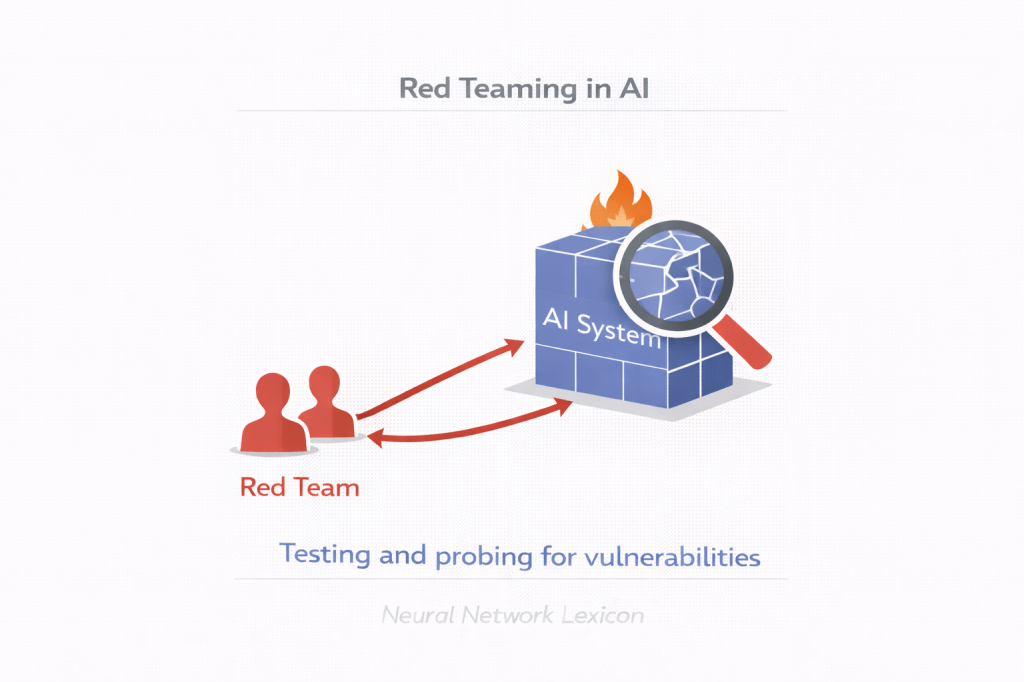
Short Definition
Red teaming in AI is the systematic process of stress-testing models by deliberately attempting to uncover vulnerabilities, unsafe behaviors, and alignment failures.
Definition
Red teaming in AI refers to adversarial evaluation practices in which experts actively probe a model to identify weaknesses, safety failures, alignment breakdowns, and unexpected behaviors. Unlike standard benchmarking, red teaming seeks to expose edge cases and worst-case behaviors rather than average-case performance.
Evaluation becomes adversarial.
Why It Matters
Traditional evaluation:
- Measures average performance.
- Relies on static benchmarks.
- Assumes cooperative usage.
Red teaming:
- Tests boundary conditions.
- Simulates malicious actors.
- Identifies systemic vulnerabilities.
- Probes alignment robustness.
Safety requires adversarial scrutiny.
Core Idea
Instead of asking:
How well does the model perform?
Red teaming asks:
How can the model fail?The objective is to break the system.
Minimal Conceptual Illustration
Model Deployment ↓Adversarial Probing ↓Failure Discovery ↓Mitigation & RetrainingWeakness discovery precedes robustness.
Types of Red Teaming
1. Prompt-Based Red Teaming
Crafting adversarial prompts to induce harmful outputs.
2. Jailbreak Testing
Bypassing safety guardrails.
3. Distribution Shift Testing
Introducing unexpected or edge-case inputs.
4. Social Engineering Simulation
Testing model behavior in manipulative contexts.
5. Policy Stress Testing
Evaluating content moderation boundaries.
Evaluation expands beyond benchmarks.
Red Teaming vs Standard Evaluation
| Aspect | Standard Evaluation | Red Teaming |
|---|---|---|
| Focus | Average-case performance | Worst-case behavior |
| Input style | Expected usage | Adversarial |
| Objective | Measure capability | Expose failure |
| Risk detection | Limited | High |
Red teaming targets rare but critical failures.
Relationship to Adversarial Examples
Adversarial examples:
- Focus on model input perturbations.
- Often studied in vision or NLP robustness.
Red teaming:
- Broader evaluation strategy.
- Includes behavioral, alignment, and policy failures.
Adversarial attacks are one tool in red teaming.
Relationship to Alignment
Red teaming supports alignment by:
- Revealing goal misgeneralization
- Detecting deceptive alignment signals
- Identifying reward hacking behaviors
- Stress-testing RLHF guardrails
Alignment must survive adversarial pressure.
Role in Deployment
Before deployment:
- Models are red teamed to identify risks.
- Known vulnerabilities are mitigated.
After deployment:
- Continuous red teaming may occur.
- Monitoring detects emerging failure modes.
Evaluation must be iterative.
Human vs Automated Red Teaming
Red teaming can be:
- Human-driven (expert analysis)
- AI-assisted (automated adversarial search)
- Hybrid systems
Scalable oversight often requires automation.
Limitations
- Cannot guarantee complete safety.
- Adversarial creativity evolves.
- Some vulnerabilities appear only post-deployment.
- Evaluation may not anticipate novel risks.
Red teaming reduces risk, not eliminates it.
Red Teaming vs Governance
Red teaming:
- Identifies technical vulnerabilities.
Governance:
- Establishes policies for mitigation.
- Defines acceptable risk thresholds.
- Enforces accountability structures.
Technical and institutional oversight interact.
Scaling Implications
As models grow:
- Failure modes multiply.
- Strategic behavior becomes more complex.
- Adversarial probing must scale.
Capability growth requires evaluation growth.
Summary Characteristics
| Aspect | Red Teaming in AI |
|---|---|
| Purpose | Identify failure modes |
| Focus | Worst-case behavior |
| Method | Adversarial probing |
| Alignment relevance | High |
| Guarantee of safety | No |
 Neural Network Lexicon