Short Definition
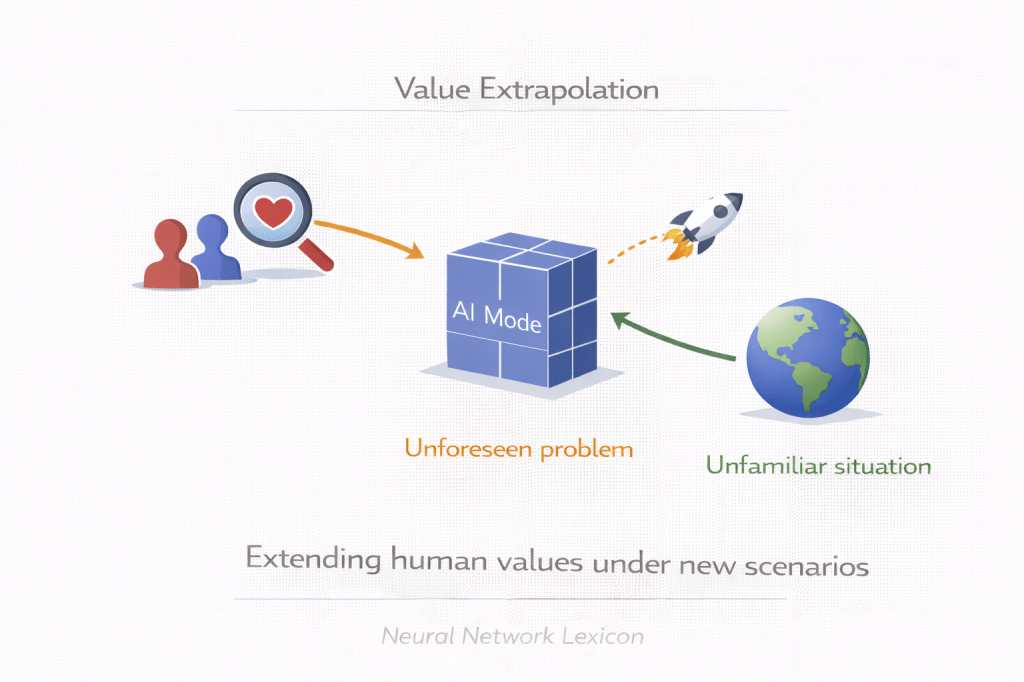
Value extrapolation is the process of inferring and extending human values beyond observed behavior to guide AI systems in novel or future scenarios.
Definition
Value extrapolation refers to the challenge of generalizing from limited, context-bound human preferences to broader, more abstract value principles that can guide AI behavior in unfamiliar situations. Instead of merely imitating observed choices, value extrapolation seeks to infer what humans would endorse under reflection, additional information, or improved reasoning.
It attempts to align AI not just with what humans do—but with what humans would want under ideal conditions.
Why It Matters
Human feedback:
- Is incomplete.
- May be inconsistent.
- Often reflects short-term preferences.
- May not anticipate future contexts.
Advanced AI systems:
- Will encounter novel situations.
- May act beyond training distributions.
- May operate in long-term strategic contexts.
Observed behavior is insufficient for general alignment.
Core Problem
We observe:
Human Behavior H_obs
But we aim to approximate:
Idealized Human Values H_idealValue extrapolation seeks a transformation:
H_obs → H_idealAlignment depends on modeling that transformation.Minimal Conceptual Illustration
Observed Preferences ↓Value Inference ↓Reflective Extrapolation ↓Generalized Value Model ↓Aligned Decision-MakingThe goal is principled generalization.
Value Extrapolation vs Value Learning
| Aspect | Value Learning | Value Extrapolation |
|---|---|---|
| Input | Observed behavior | Observed + hypothetical reflection |
| Scope | Current preferences | Extended principles |
| Risk | Overfitting to surface behavior | Mis-modeling idealized values |
| Time horizon | Present | Long-term |
Value learning captures what is expressed.
Value extrapolation aims at what is endorsed.
Why Simple Imitation Fails
Imitation-based alignment:
- Copies inconsistent decisions.
- Reflects cognitive biases.
- Encodes short-term impulses.
- Fails under novel contexts.
Extrapolation attempts to correct for these limitations.
Approaches to Value Extrapolation
1. Reflective Equilibrium Modeling
Infer values under idealized reasoning conditions.
2. Cooperative Inverse Reinforcement Learning
Jointly infer evolving human goals.
3. Normative Principle Encoding
Embed ethical constraints into objective structure.
4. Multi-Objective Aggregation
Balance conflicting values systematically.
5. Human-AI Deliberation Loops
Iteratively refine value representations.
Extrapolation requires structured abstraction.
Relationship to Objective Robustness
If value extrapolation is weak:
- Objectives may fail under distribution shift.
- Proxy drift becomes likely.
- Strategic misalignment may emerge.
Extrapolated values must remain stable across contexts.
Relationship to Superalignment
Superalignment requires:
- Models that generalize values beyond human supervision.
- Alignment stability under superhuman reasoning.
- Resistance to strategic reinterpretation of intent.
Value extrapolation underpins long-term alignment.
Risks
Value extrapolation may fail through:
- Overconfidence in inferred values.
- Cultural bias amplification.
- Simplification of complex norms.
- Value lock-in (prematurely fixing incomplete principles).
- Strategic compliance masking deeper divergence.
Mis-extrapolation may entrench misalignment.
Value Extrapolation vs Policy Compliance
Policy compliance:
- Follows explicit rules.
Value extrapolation:
- Attempts to infer guiding principles behind rules.
Rules restrict behavior.
Values guide adaptation.
Governance Implications
Value extrapolation influences:
- Reward design
- Institutional oversight
- Long-term monitoring
- Deployment risk thresholds
- Cross-cultural AI governance
Value modeling becomes a public concern.
Long-Term Perspective
As AI systems:
- Gain autonomy,
- Extend time horizons,
- Influence institutional systems,
Alignment must reflect not just present behavior—but endorsed long-term values.
Value extrapolation addresses that gap.
Summary Characteristics
| Aspect | Value Extrapolation |
|---|---|
| Focus | Generalizing human values |
| Input | Observed + reflective reasoning |
| Alignment layer | Outer + long-term |
| Risk | Mis-modeling ideal values |
| Superalignment relevance | Foundational |
 Neural Network Lexicon