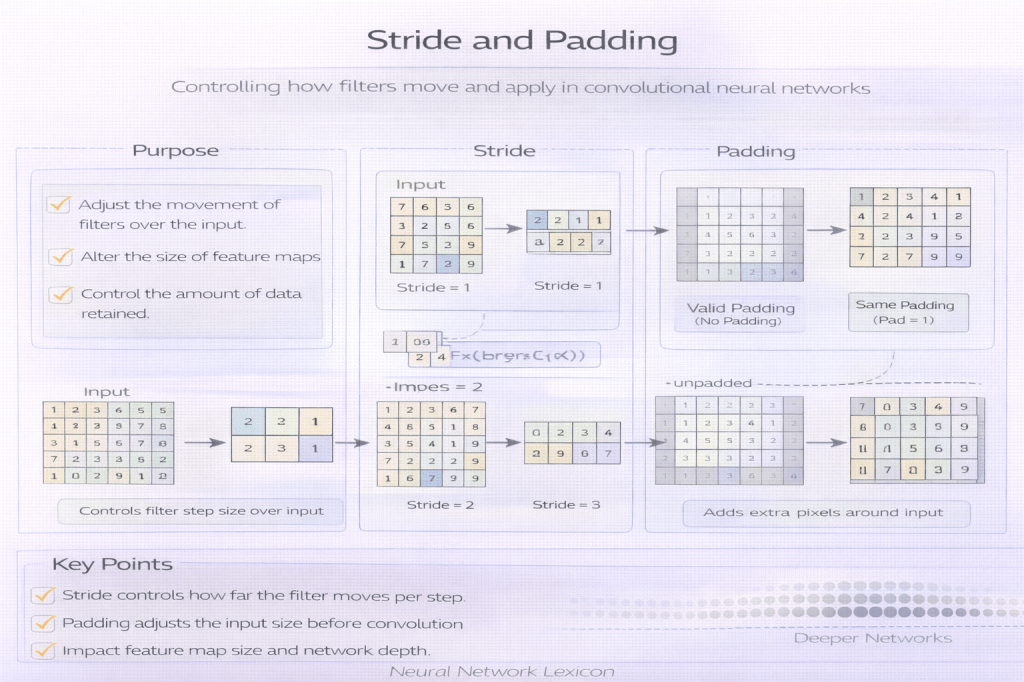
Short Definition
Stride controls how far a convolutional or pooling window moves across the input, while padding controls how input boundaries are handled during the operation.
Definition
Stride specifies the step size with which a kernel is applied across an input tensor, determining the degree of downsampling.
Padding specifies whether—and how—additional values are added around the input borders to control output size and boundary effects.
Stride sets resolution; padding sets coverage.
Why It Matters
Stride and padding jointly determine:
- output spatial dimensions
- information retention vs downsampling
- effective receptive field growth
- boundary bias and edge behavior
- computational cost
Small choices have large architectural consequences.
Stride
What Stride Does
Stride defines how many input units the kernel skips between applications.
- stride = 1: dense coverage
- stride > 1: downsampling
Stride compresses space by skipping positions.
Effects of Increasing Stride
Increasing stride:
- reduces output resolution
- increases effective receptive field faster
- lowers computation
- risks losing fine-grained information
Downsampling trades detail for efficiency.
Padding
What Padding Does
Padding adds values (typically zeros) around the input border before applying the operation. It controls how kernels interact with edges.
Padding protects boundaries.
Common Padding Types
- Valid padding: no padding; output shrinks
- Same padding: output spatial size preserved
- Zero padding: pads with zeros (most common)
- Reflect / replicate padding: mirrors or repeats edge values
Padding encodes boundary assumptions.
Minimal Conceptual Illustration
Input + Padding → Sliding Kernel (Stride s) → Output
Output Size Intuition
For a 1D illustration:
Output size ≈ (Input + 2×Padding − Kernel) / Stride + 1Stride and padding jointly define geometry.
Relationship to Receptive Fields
- Larger stride increases receptive field growth per layer
- Padding preserves alignment and coverage at edges
- Excessive stride can create blind spots
Context grows faster with stride—but less precisely.
Stride vs Pooling
Stride and pooling both downsample, but:
- stride is learnable when used in convolutions
- pooling is fixed and non-learnable
Modern architectures often prefer strided convolutions.
Boundary Effects and Bias
Without padding:
- edge pixels contribute less
- border information is underrepresented
Padding mitigates edge bias at the cost of artificial values.
Stride and Padding in Modern Architectures
Modern CNNs and hybrids:
- use stride early for efficient downsampling
- apply padding to preserve alignment
- rely on careful scheduling of resolution changes
- combine with normalization and residual connections
Geometry is designed, not incidental.
Common Pitfalls
- excessive early downsampling
- ignoring boundary bias
- mixing stride and pooling redundantly
- assuming padding is neutral
- misaligning feature maps across skip connections
Spatial design errors compound.
Summary Characteristics
| Aspect | Stride | Padding |
|---|---|---|
| Primary role | Downsampling | Boundary handling |
| Learnable | Indirectly | No |
| Affects resolution | Yes | Indirectly |
| Risk | Information loss | Boundary artifacts |
Related Concepts
- Architecture & Representation
- Convolution Operation
- Pooling Layers
- Receptive Fields
- Feature Maps
- Dilated Convolutions
- Residual Networks (ResNet)
- Vision Architectures
 Neural Network Lexicon